Our Array Platforms

We offer advanced DNA methylation arrays to support a wide range of study types, from targeted interventions to multi-omic population health initiatives.

Methylation Screening Array (MSA)

The Infinium Methylation Screening Array (MSA) is a high-throughput, cost-effective solution tailored for large-scale epigenetic studies. With approximately 270,000 probes, it is optimized for measuring aging, environmental exposures, and metabolic traits. The platform supports up to 48 samples per chip, includes both CpG methylation and SNP probes, and is an excellent choice for large-scale or multi-omic studies where throughput and affordability matter.

Key Features:

  • High-Throughput Capability: Supports up to 48 samples per BeadChip, facilitating large-scale studies.
  • Focused Content: Includes probes associated with traits such as aging, environmental exposures, and metabolic diseases.
  • Cost-Effective: Designed to provide comprehensive data at a reduced cost compared to broader arrays.
  • Multi-Omic Integration: Incorporates content for CpH methylation and single nucleotide polymorphisms (SNPs), enriching the dataset for integrative analyses.
Biological Age Clocks

Many existing DNA methylation algorithms were developed on EPIC array data and don’t always work on the MSA platform. To address this, we developed a suite of custom algorithms trained directly on MSA data to maximize its research utility. In collaboration with research partners at Harvard, Duke, and Yale, we created novel biological age measures specifically validated for the MSA array – several of which are now considered industry-leading standards for longevity, including:

  • DunedinPACE: Measures the pace of aging
  • SymphonyAge: Estimates organ-level age
  • OMICmAge: Measures biological age

Cellular Deconvolution

Beyond aging, we have also engineered cellular deconvolution models tailored to MSA data:

  • Cellular deconvolution: The process of identifying and quantifying the different cell types present in a biological sample based solely on DNA methylation data.
  • We’ve engineered advanced 19-cell immune deconvolution models that allow us to track even subtle shifts in immune cell populations– insight that is essential for aging, inflammation, autoimmunity, and therapeutic response analysis.

Epigenetic Biomarker Proxies (EBPs)

In collaboration with Harvard, we have also developed 1,700 Epigenetic Biomarker Proxies (EBPs) trained on MSA data. These biomarkers predict metabolites, proteins, and clinical values, and have been shown to outperform traditional lab tests in precision and reliability from an at-home dried blood spot sample. Unlike traditional biomarkers that provide momentary snapshots, EBPs reflect biomarker levels averaged over weeks or months, offering a dynamic and comprehensive assessment of health.

Cross-Array Reference Set

With over 2,000 paired EPICv1 and MSA samples, TruDiagnostic has created a robust reference resource to improve cross-array probe reliability and algorithm corrections. In addition, we maintain large replication and validation datasets across multiple array platforms. 


Together, these datasets make the MSA a powerful choice for population health studies, disease prediction research, and multi-omic integration projects, delivering both scale and scientific depth.

Biological Age Clocks

Many existing DNA methylation algorithms were developed on EPIC array data and don’t always work on the MSA platform. To address this, we developed a suite of custom algorithms trained directly on MSA data to maximize its research utility. In collaboration with research partners at Harvard, Duke, and Yale, we created novel biological age measures specifically validated for the MSA array – several of which are now considered industry-leading standards for longevity, including:

  • DunedinPACE: Measures the pace of aging
  • SymphonyAge: Estimates organ-level age
  • OMICmAge: Measures biological age

Cellular Deconvolution

Beyond aging, we have also engineered cellular deconvolution models tailored to MSA data:

  • Cellular deconvolution: The process of identifying and quantifying the different cell types present in a biological sample based solely on DNA methylation data.
  • We’ve engineered advanced 19-cell immune deconvolution models that allow us to track even subtle shifts in immune cell populations– insight that is essential for aging, inflammation, autoimmunity, and therapeutic response analysis.

Epigenetic Biomarker Proxies (EBPs)

In collaboration with Harvard, we have also developed 1,700 Epigenetic Biomarker Proxies (EBPs) trained on MSA data. These biomarkers predict metabolites, proteins, and clinical values, and have been shown to outperform traditional lab tests in precision and reliability from an at-home dried blood spot sample. Unlike traditional biomarkers that provide momentary snapshots, EBPs reflect biomarker levels averaged over weeks or months, offering a dynamic and comprehensive assessment of health.

Cross-Array Reference Set

With over 2,000 paired EPICv1 and MSA samples, TruDiagnostic has created a robust reference resource to improve cross-array probe reliability and algorithm corrections. In addition, we maintain large replication and validation datasets across multiple array platforms. 


Together, these datasets make the MSA a powerful choice for population health studies, disease prediction research, and multi-omic integration projects, delivering both scale and scientific depth.

EPIC v2.0 Array

The EPIC v2.0 array offers a comprehensive genome-wide analysis with approximately 930,000 methylation sites measured. As a result, the EPIC v2.0 provides extensive coverage of CpG islands, enhancers, and other regulatory regions, making it ideal for in-depth epigenetic research, such as studies focused on cancer research, genetic diseases, and molecular epidemiology.

Key Features:

  • Extensive Coverage: Targets over 99% of RefSeq genes, including promoter and enhancer regions.
  • Enhanced Content: Includes additional probes for regions identified through ATAC-Seq and ChIP-Seq experiments.
  • Advanced Analysis Tools: Compatible with bioinformatics tools like SeSAMe and minfi for data processing and analysis.
  • Multi-Omic Integration: Incorporates content for CpH methylation and single nucleotide polymorphisms (SNPs), enriching the dataset for integrative analyses.

We helped validate the performance of the EPIC v2.0 array in this publication, which demonstrated expanded enhancer coverage, reliable results across diverse ancestries, support for low-input DNA (~1 ng), and preserved coverage of key tools like epigenetic clocks and immune deconvolution panels.

Additionally, we have run over 100,000 EPIC (V1.0 and V2.0) samples since our inception and have a full suite of algorithms trained on both platforms, including:

  • 30+ biological age clocks
  • 4 mitotic clocks
  • 12- and 19-cell immune deconvolution
  • 1,700+ Epigenetic Biomarker Proxies described here
  • 100+ longitudinal intervention datasets
  • Diagnostic and risk predictive Methylation Risk Scores (MRS) for 40+ different disease conditions

Xtra DNAm Array

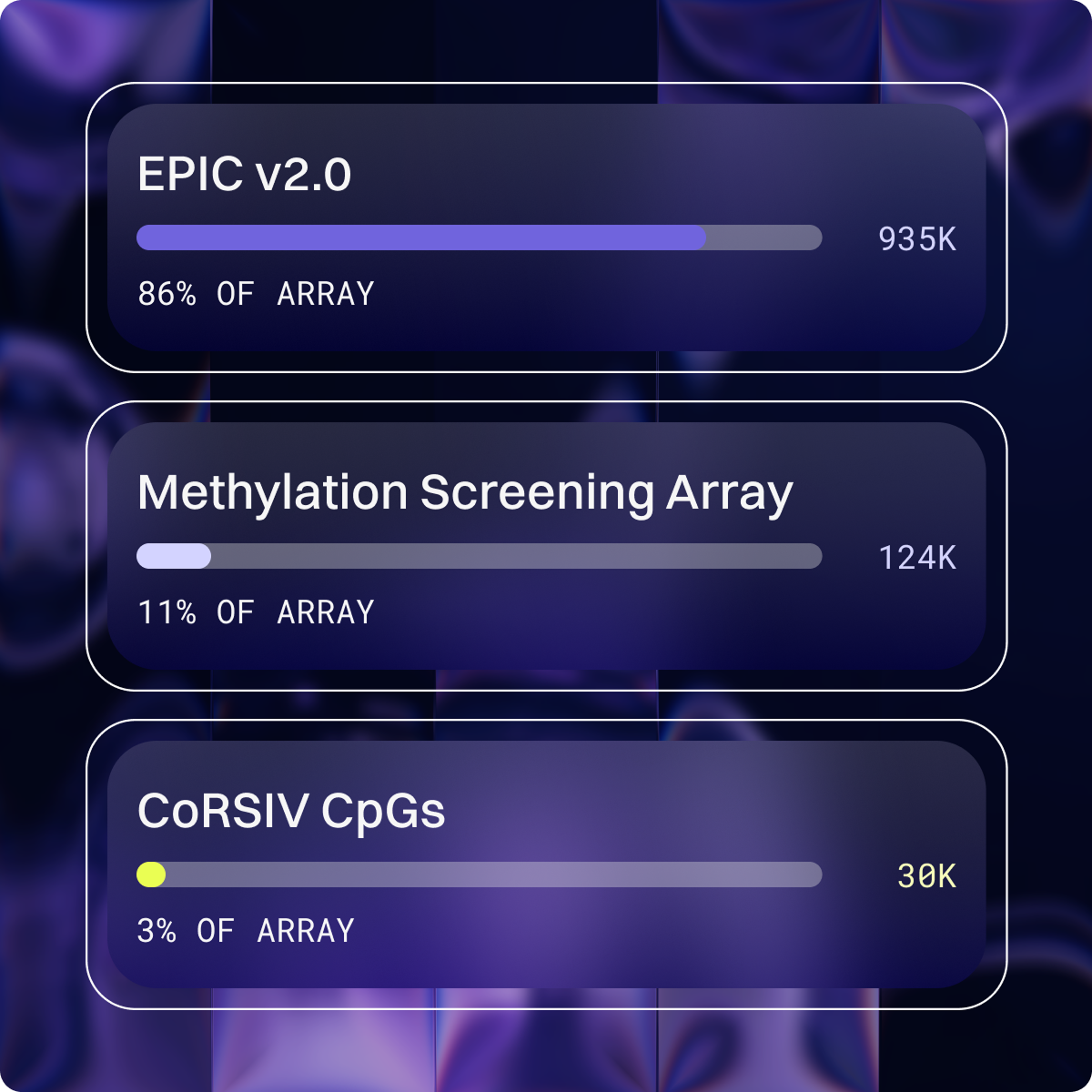
The Illumina Xtra DNAm Array combines the strengths of the MSA and EPIC v2.0 arrays with an additional 30,000 specially selected regions measured, totaling 1.09 million methylation sites. Notably, these custom regions are designed to include at least 3 CpGs from each Correlated Region of Systemic Interindividual Variation (CoRSIV).

Key Features:

  • Comprehensive Coverage: Integrates content from MSA and EPIC v2.0 arrays with additional CoRSIV-targeted regions.
  • Enhanced Phenotypic Relevance: CoRSIVs are associated with various human diseases, including obesity, cancer, and neurological disorders.
  • High Phenotypic Relevance: CoRSIVs are approximately 50-100 times more phenotypically relevant than other regions, offering deeper insights into disease mechanisms.

We helped validate the performance of the EPIC v2.0 array in this publication, which demonstrated expanded enhancer coverage, reliable results across diverse ancestries, support for low-input DNA (~1 ng), and preserved coverage of key tools like epigenetic clocks and immune deconvolution panels.

Enrichment of CoRSIV-overlapping probes was observed for most classes of disease, indicating an opportunity to improve the power of EWAS by over 200- and over 100-fold, respectively. EWAS targeting all known CoRSIVs should accelerate discovery of associations between individual epigenetic variation and risk of disease.

CoRSIVs are genomic regions where DNA methylation patterns show consistent variation between individuals across different tissues. This makes them especially valuable for studies exploring the epigenetic basis of complex traits and diseases. Unlike most CpGs, CoRSIVs capture stable interindividual differences that are often more phenotypically informative. CoRSIVs are related to health outcomes more than any other region, making this array an excellent measure for biological health predictions.  For instance, data has shown that these regions are 50-100x more phenotypically penetrant (equivalent to 1.5M-3M CpGs).  
Imprintome Array

Our proprietary platform for analyzing epigenetic imprinting: the Imprintome Array offers dense coverage across all known and predicted imprinting control regions (ICRs), differentially methylated regions (DMRs), and key regulatory elements that influence imprinted gene networks, making this array ideal for imprinting discovery and diagnostics.

Key Features:

  • Targeted Imprintome Coverage: Profiles ~200 known and predicted imprinted regions, including maternal and paternal allele-specific methylation zones.
  • Designed for Disease-Relevant Discovery: Ideal for studying disorders of imprinting, developmental syndromes, aging, and transgenerational epigenetic inheritance.
  • High-CpG Density Per Region: Each region contains multiple CpG sites (typically 3-15), providing robust statistical power and methylation state clarity.
  • Cross-Compatible with Multi-Omic Pipelines: Designed for seamless integration with transcriptomics, proteomics, and single-cell methylation tools.

“Enrichment of CoRSIV-overlapping probes was observed for most classes of disease, indicating an opportunity to improve the power of EWAS by over 200- and over 100-fold, respectively. EWAS targeting all known CoRSIVs should accelerate discovery of associations between individual epigenetic variation and risk of disease.”

Imprinted genes are uniquely susceptible to epigenetic dysregulation. Unlike other loci, they are monoallelically expressed, meaning they rely on precise methylation signals from only one parental chromosome. When these signals go awry, the resulting phenotypes can be severe and systemic.

Recent studies have linked aberrant imprinting methylation to:
Autism Spectrum Disorders
Obesity & Insulin Resistance
Cancer Progression
Accelerate Epigenetic Aging
Neurodevelopmental Delays

Unlike most DNA methylation CpGs, these behave more like genetics with consistency among tissues and throughout time. To address the growing need for precise methylation profiling in these regions, we developed the Imprintome array, the world’s first commercially available DNA methylation array focused exclusively on imprinting control regions, in combination with researchers from North Carolina State University.
Partner With Us

Whether you're launching a new trial, scaling an ongoing study, or exploring epigenetic biomarkers for the first time, we're here to support your team every step of the way.