.png)


.png)
.png)
.png)
.png)
.png)
The Epigenetic Panel Precision Care Requires
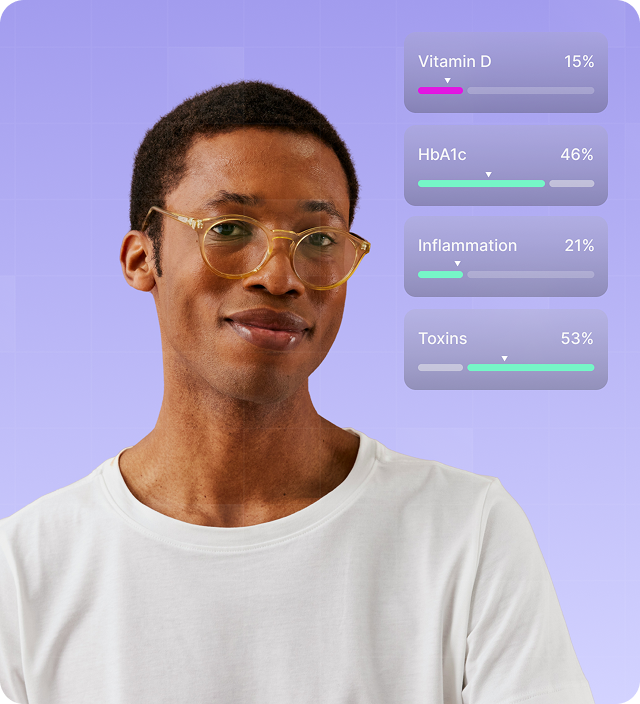

One test. Nineteen vital health systems.
Retinol (Vitamin A), Nicotinamide, Pantothenic Acid (B5), Pyridoxine / Pyridoxine-5-Phosphate (B6), Inositol, Cholecalciferol (Vitamin D), Alpha-tocopherol, Total Cholines, Betaine
Methionine, Cysteine, S-methylmethionine, Taurine, Ergothioneine, Glutamine, Arginine, Tyrosine, L-Aspartic Acid, N-carbamoylvaline, Asparagine, N-acetylthreonine, N-acetylvaline, Glycine, Cystathionine, N-acetylhistidine, Citrulline
Retinol (Vitamin A), Alpha-tocopherol, Lutein, Carotene Diol, Acetyl-L-Carnitine, Ergothioneine
Omega-3, DHA, Docosapentaenoic Acid, EPA, Omega-6, LA, PUFA, MUFA, SFA, Pentadecanoate (C15:0), Phosphoglycerides, Phosphatidylcholines, Sphingomyelins
Phospholipase A2, Octadecadienedioate (C18:2-DC)
LDL-C, LDL Particle Size, VLDL-C, VLDL Particle Size, ApoA1, HDL-C, HDL Particle Size, Total Triglycerides, Remnant Cholesterol, ApoC-II, APOE, PCSK9
Vanillactic Acid, Phenylacetylglutamine, Systolic Blood Pressure, Dimethylarginine (SDMA and ADMA)
HbA1c, Glucose, Palmitoylcarnitine, Leptin, Phenylacetylglutamine, IGF-1, Adiponectin, Cystatin-C, Erythritol, Homocitrulline
White Blood Cell Count, Neutrophil Count, Lymphocyte Count, CRP, Neutrophil-to-Lymphocyte Ratio (NLR), Systemic Immune-Inflammation Index (SII), CD4/CD8 Ratio
Neurogranin, Quinolinate, Dopamine 3-O-sulfate, Dopamine 4-sulfate, TGF-beta, Progranulin, Neurosecretory Protein VGF
CRP, IL-6, Methionine Sulfone, Serum Amyloid A-1 Protein, Glycoprotein Acetyls
Cortisol, Vanilmandelic Acid (VMA), Kynurenine, DHEA Sulfate
PFOS, PFOA, HPMA, 2-hydroxyfluorene Sulfate
Urate, Xanthine, Allantoin
ATP Synthase Subunit Beta (ATP5B)
Methionine Sulfone, Allantoin, Dimethyllysine, HSP-90 Alpha, G6PD
Nicotinamide, Nicotinamide Riboside, 1-Methylnicotinamide
3-Hydroxybutyrate (BHBA), Acetoacetate
Alpha-Ketoglutarate, Spermidine
The Results of Epigenetic Testing


From Epigenetic Data to Clinical Next Steps
TruHealth translates epigenetic findings into specific clinical recommendations – developed with Harvard researchers and practicing clinicians so the guidance fits how you actually work.
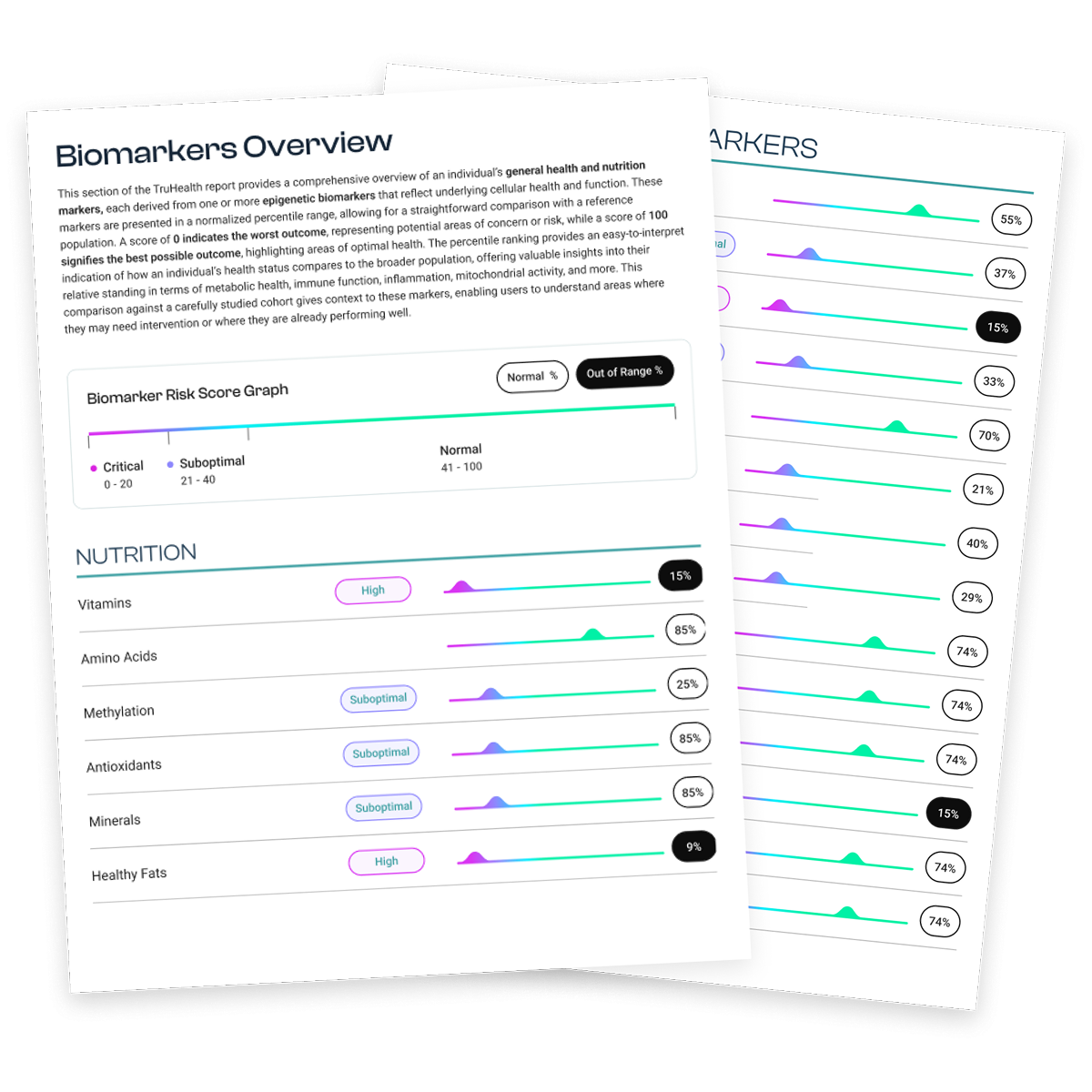
What TruHealth Adds to Your Clinical Workflow
An initial test establishes where your patient stands biologically today, giving you the clinical anchor that turns every follow-up visit into a progress conversation.
When your patient’s history and labs leave the picture incomplete, fill the gaps with the biological context you need to build a care plan that actually fits.
Show whether the protocols you’re recommending are actually working at the biological level, giving your patients evidence that lifestyle changes are making a measurable difference.
When a patient has multiple concerns, testing helps you see which biological systems need the most attention, turning a complex clinical picture into a clear set of priorities.
How does TruHealth work?

Order TruHealth for Your Practice

Patient Sample Collection

Receive Actionable Results
Uncover the root cause of unexplained symptoms
Why Physicians Choose TruHealth
FAQs
TruHealth measures 105+ epigenetic biomarkers from a single at-home finger prick, mapped to 19 biological systems and organized into 7 clinical categories:
• Nutrition — Vitamins (A, B2, B3, B5, B6, B8, C, D, E, Choline, Betaine), Amino Acids (Methionine, Cysteine, S-Methylmethionine, Taurine, Ergothioneine, Glutamine, Arginine, L-Aspartic Acid, Valine, Asparagine, Threonine, Glycine, Carnosine, Cystathionine, Histidine, Citrulline, Dimethylarginine, ADMA and SDMA, Homocitrulline, Dimethyllysine), Antioxidants (Acetyl-L-Carnitine, Carotenoids), and Fats & Cellular Membranes (Omega 3, DHA, DPA, EPA, Omega 6, LA, PUFA, MUFA, SFA, Pentadecanoate, Phosphoglycerides, Phosphatidylcholine, Sphingomyelins).
• Glycemic & Metabolic — Metabolic Markers (HgbA1c, Glucose, Fat Burning Marker, Satiety Hormone, Phenylalanine Dysbiosis Marker, Adiponectin, Erythritol), Ketones (Beta Hydroxybutyrate), Uric Acid Pathway (Uric Acid, Xanthine, Allantoin).
• Mitochondrial & Oxidative — Mitochondrial Function (Energy Balance Marker, ATP Synthase, Energy Transport Protein), Oxidative Defense (Myeloperoxidase, Oxidative Stress Indicator, Oxidative Damage Marker), NAD+ Metabolism (Byproduct Marker, 1-MNA).
• Lipid & Vascular — Lipid Peroxidation (Phospholipase A2, Glutathione Peroxidase, Octadecadienedioate C18:2-DC), Serum Lipids (ApoB, LDL-C, LDL Particle Size, VLDL-C, VLDL Particle Size, ApoA1, HDL-C, HDL Particle Size, Total Triglycerides, Remnant Cholesterol, ApoC-II, APOE, PCSK9), Blood Pressure (Vanilla Acetic Acid, Phenylacetylglutamine).
• Immune & Inflammation — Immune Markers (White Blood Cell Count, Neutrophil Count, Lymphocyte Count, CRP, Neutrophil to Lymphocyte Ratio, Systemic Immune-Inflammation Index, CD4/CD8 Ratio, Cystatin-C, HSP-90 alpha), Inflammation Markers (IL-6, Oxidative Stress Marker, Serum Amyloid A-1 Protein, Glycoprotein Acetyls, IGF-1, DHEA Sulfate).
• Toxins & Exposures — PFAS, Acrolein, Polycyclic Aromatic Hydrocarbons, Pesticides, Lead Exposure.
• Neurocognitive & Stress — Neurocognitive Markers (Memory Health Protein, Brain Inflammation Marker, Cell Repair Marker, Brain Anti-Inflammatory Protein, VGF), Stress Markers (Adrenal Activity Marker, Chronic Stress Marker).
Together, these 100+ biomarkers reveal a longer-horizon biological signal across nutrition, metabolic flexibility, mitochondrial capacity, inflammation, toxin burden, and cognitive-stress load — surfacing what may be quietly driving symptoms that conventional panels miss.
TruHealth measures functional and nutritional health through DNA methylation analysis — the same epigenetic technology that powers TruAge — applied to surrogate biomarkers across nutrition, metabolic, immune, mitochondrial, and other functional pathways. Rather than relying solely on direct serum concentrations of vitamins, amino acids, and metabolites — which fluctuate hour-to-hour with meals, hydration, and acute stress — TruHealth reads methylation patterns at more than 1,000,000 CpG sites that reflect a sustained biological signal across weeks to months. This gives providers a stable, system-level view of where a patient's biology actually sits, from a single finger prick.
Many of the conditions that providers spend the most time managing — chronic fatigue, brain fog, cardiometabolic risk, autoimmune flares, persistent inflammation — are downstream of upstream nutritional and functional imbalances that standard labs are not designed to surface.
Conventional micronutrient panels are snapshot measurements: a single number, measured in plasma or serum, highly sensitive to what a patient ate that morning or how hydrated they are. TruHealth's epigenetic methodology, by contrast, reflects a sustained biological signal across weeks to months — making it more clinically meaningful than a one-day blood result.
Crucially, epigenetic biomarkers are modifiable. Unlike a fixed genetic test, methylation patterns shift in response to diet, supplementation, sleep, exercise, and pharmacologic intervention — making TruHealth a powerful tool for longitudinal monitoring of what's actually working at the cellular level, not just clinical endpoints.
TruHealth is most clinically useful for patients whose symptoms or risk factors aren't fully explained by standard workups, and for providers building personalized nutrition, lifestyle, or longevity protocols.
• Patients with unexplained fatigue, brain fog, or persistent low mood whose conventional labs keep returning normal
• Patients with borderline metabolic markers (lipids, HbA1c, blood pressure) whose current protocol improves labs but not symptoms
• Patients on active interventions — supplementation, dietary protocols, GLP-1 agonists, peptides — where you want to measure cellular response, not just clinical endpoints
• Patients with chronic inflammation, autoimmune flares, or borderline immune dysfunction without a clear driver
• Patients invested in longevity and preventive medicine who want a quantitative baseline of their functional biology, with the ability to retest every three to six months
• Patients with suspected environmental exposure burden (toxins, heavy metals, PFAS) and no objective workup
Because TruHealth is not a diagnostic test, it is best positioned as an adjunct to clinical evaluation — a longitudinal functional signal to complement, not replace, standard workup.
TruHealth's biomarker panels are built on the same epigenetic methodology that powers TruAge, and are developed and validated in partnership with Harvard University. The underlying CpG signatures have been benchmarked across multiple independent cohorts and published in peer-reviewed literature.
Providers order directly through the TruDiagnostic Provider Portal. Once your account is set up, you can place orders for clinic delivery or patient drop-ship.
Full pricing is available in the Provider Portal once your account is active. To get started, register as a provider at www.trudiagnostic.com/provider-application.