.png)


.png)
.png)
.png)
.png)
.png)
Epigenetics
Key Concepts
Epigenetic biomarkers
Epigenetic clocks
Core Principles
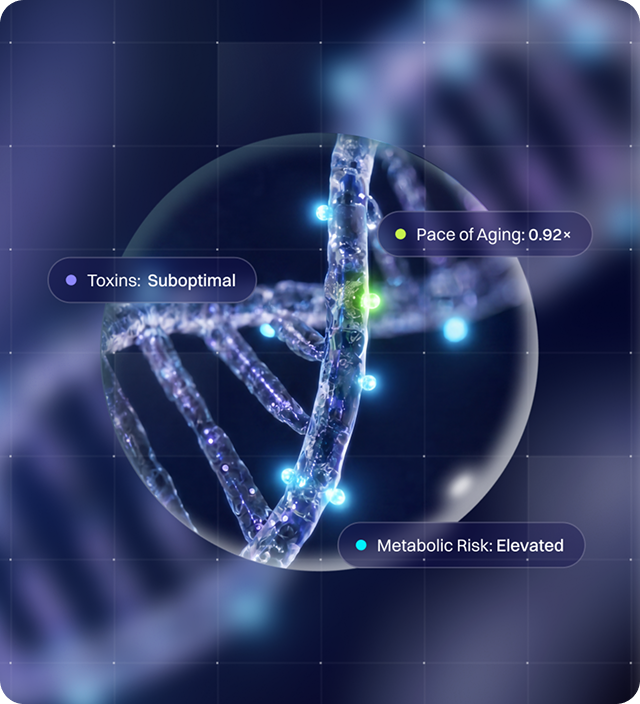
Epigenetics is the study of how your behaviors and environment can cause changes that affect the way your genes work. Unlike genetic changes, epigenetic changes are reversible and do not change your DNA sequence, but they can change how your body reads a DNA sequence. Think of it as a dynamic and responsive layering of information on top of your static genome.
Genetics is the sequence you inherit. Epigenetics is the layer of regulation that influences which genes are more active or less active in different cells and contexts.
In an 8-week intervention study co-authored by TruDiagnostic researchers (the Stanford Twins Nutrition Study), a healthy vegan diet was associated with measurable shifts in DNA methylation-based aging signals compared to a healthy omnivorous diet. The vegan group showed reductions in epigenetic age acceleration across multiple clocks and improvements across several system-level aging domains, while the omnivorous group did not show significant changes. This is a clear "epigenetics in the wild" example that everyday inputs like diet can leave detectable molecular patterns in DNA methylation.
Epigenetic testing provides objective, quantifiable data about a patient's biological age and system-specific health markers. Unlike traditional lab values that measure current state, epigenetic biomarkers can indicate future health trajectories and help assess the effectiveness of interventions. This allows providers to personalize treatment plans, track patient progress with precision, and offer data-driven insights for preventive health strategies.
Modern epigenetic clocks, particularly third-generation models, show high correlation with biological age and health outcomes. These algorithms are trained on large datasets and validated across diverse populations. The accuracy continues to improve as more data becomes available. For clinical use, these measurements provide reliable indicators for monitoring retesting and assessing intervention impacts over time.
Epigenetic Biomarkers
DNA Methylation




What is DNA methylation?

Does methylation mean a gene is "on" or "off"?
Where it is in the genome matters: For example, methylation near a gene's promoter is often associated with reduced expression, while methylation in other regions can have different relationships.
Cell type and context matter: The same methylation change can have different implications depending on the gene, tissue, immune cell composition, age, and environment.

Is methylation "good" or "bad"?
Epigenetic Clocks

First-Generation Clocks

Second-Generation Clocks
Third-Generation Clocks
The Aging Analogy
OMICmAge™
Provides the primary headline signal of biological age. It is a comprehensive aggregate but not organ-level.
SYMPHONYAge™
Breaks down biological age by organ systems, showing where aging may be accelerated or decelerated.
DunedinPACE™
Measures the pace of aging < 1.0 means you are aging slower than your chronological age; >1.0 means you are aging faster.
System-based Health
Our TruHealth test looks at 110+ key biomarkers across vitamins, antioxidants, amino acids, healthy fats, and other factors that impact your health, sleep, and performance. These model-derived outputs measure cellular function across 19 biological systems, organized into 7 clinical categories.
The Molecular Imprint

Environmental

Nutritional

Behavioral
Evidence & Methodology
50+
115+
80+








Ready to use epigenetics in practice?