.png)


.png)
.png)
.png)
.png)
.png)
CLINICAL CASE 01
When Standard Labs Miss Disease
A fit, symptom-free 46-year-old man wanted to optimize his health. His routine labs looked reassuring. But the epigenetic biomarkers in his TruAge and TruHealth results revealed a hidden atherogenic pattern.
Follow-up testing that he'd never have done otherwise confirmed dyslipidemia, and a CT angiogram showed coronary plaque.
Standard screening missed these subtle shifts in the patient’s biology. Epigenetics detected cardiovascular disease years before symptoms would have been felt.
Follow-up testing that he'd never have done otherwise confirmed dyslipidemia, and a CT angiogram showed coronary plaque.
Standard screening missed these subtle shifts in the patient’s biology. Epigenetics detected cardiovascular disease years before symptoms would have been felt.

TRUAGE™ CLOCKS
Even his biological age agreed: he was aging slower than his peers.
Biological ages suggest he's doing most things right — but maybe not everything. Some risk may not be fully within his control.
OMICmAge™ / Biological Age
-4.5
Younger
SYMPHONYAge™ / Systems-level Age
-1.5
Younger
DunedinPACE™ / Pace of Aging
0.83
Aging Slowly
BIOMARKERS
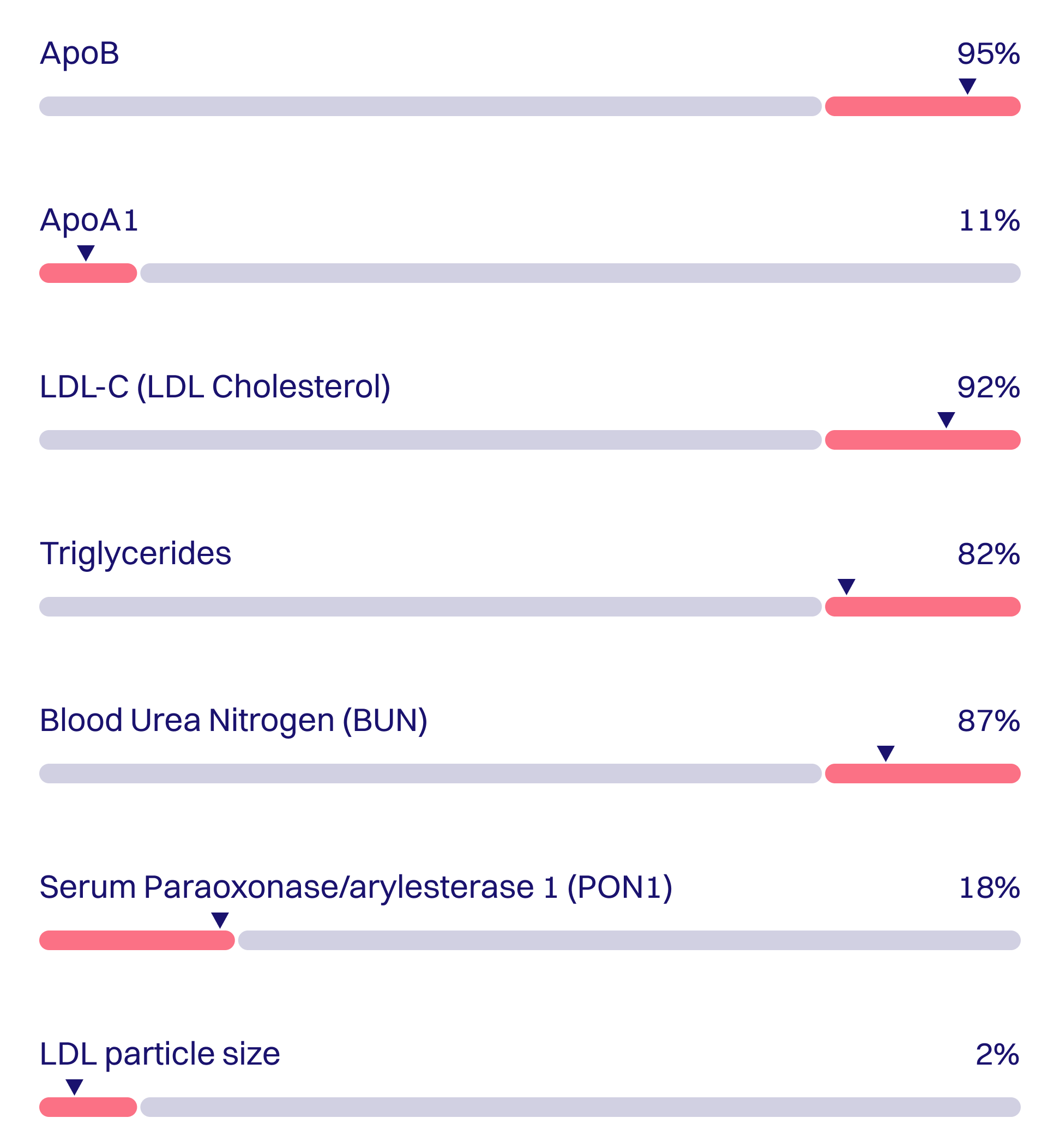
But the epigenetics told a different story.
When we look at the combination of low PON1 and ApoA1 levels, alongside high ApoB and the presence of small dense LDL, it paints a concerning picture of cardiovascular risk, even for someone who is otherwise fit. These various indicators come together to highlight potential issues in the lipid and cardiovascular pathways.
CLINICAL ACTION
The signals sent him for a closer look he’d never have been referred for.
Based on the epigenetic biomarker results, his clinician sent him for further testing.
WHAT IT CAUGHT
The Key Clinical Takeaway
Being physically fit does not equal low risk. Epigenetic biomarkers correlated strongly with conventional labs — and identified cardiovascular risk that might have gone undetected.
INTERPRETIVE FRAMEWORK
4-Step Approach to Interpreting Epigenetic Reports
Applicable across TruAge and TruHealth reports for any patient profile
Back to Case Studies
Consider Context at Collection
Was the patient's biology in a stable state? Recent infection, surgery, medication changes, or dramatic lifestyle shifts can move epigenetic signals.
Use Biological Ages for Orientation
Clocks are headlines — not conclusions. Younger biological age suggests optimization; older suggests more systemic concern. Don't act on clocks alone.
Read for Themes & Patterns
Two or more signals converging on the same pathway = treat as real until proven otherwise. One isolated marker = hypothesis only. Cross-reference TruAge and TruHealth together.
Convert Signals to a Treatment Plan
Two or more signals converging on the same pathway = treat as real until proven otherwise. One isolated marker = hypothesis only. Cross-reference TruAge and TruHealth together.