.png)


.png)
.png)
.png)
.png)
.png)
CLINICAL CASE 02
The Patient Whose Habits Were Quietly Adding Up
A 39-year-old woman identifies as "busy but healthy" — two kids, jogging 2–3x/week, high-protein diet.
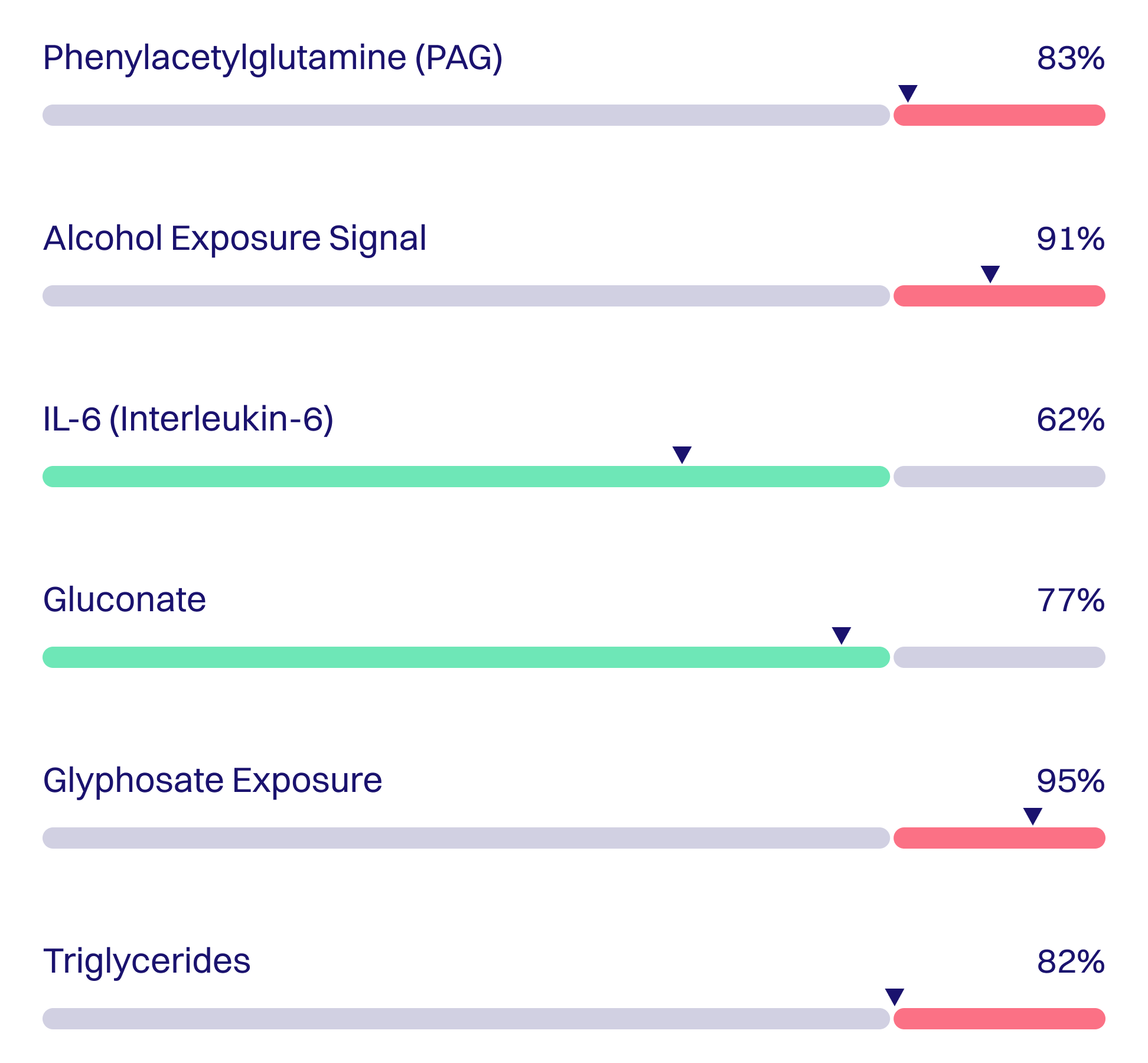
Her TruAge and TruHealth results revealed elevated alcohol exposure, triglycerides, and PAG — early cardiometabolic and gut-health risk hiding under a healthy routine.
Epigenetics caught the risk before it became a diagnosis, prompting repeat labs and targeted changes she started before her next visit.
Her TruAge and TruHealth results revealed elevated alcohol exposure, triglycerides, and PAG — early cardiometabolic and gut-health risk hiding under a healthy routine.
Epigenetics caught the risk before it became a diagnosis, prompting repeat labs and targeted changes she started before her next visit.

TRUAGE™ CLOCKS
She was aging slower than her peers.
Biologically younger than most peers and aging slowly. Any out-of-range signals likely reflect areas to optimize — not overhaul.
OMICmAge™ / Biological Age
-5.6
Younger
SYMPHONYAge™ / Systems-level Age
-1.4
Younger
DunedinPACE™ / Pace of Aging
0.94
Aging Slowly
BIOMARKERS
Mostly strong scores — with a few signals worth optimizing.
The standout epigenetic biomarkers clustered around diet quality, the gut microbiome, and alcohol. Phenylacetylglutamine, triglycerides, and an alcohol-exposure signal converged on a cardiometabolic and gut-health story — none alarming alone, but together they pointed to clear, modifiable opportunities.
CLINICAL & PATIENT-INITIATED ACTION
The signals pointed to specific, modifiable changes — several she started herself.
Her clinician recommended targeted follow-up, and she began several lifestyle changes before her next visit.
WHAT IT CHANGED
The Key Clinical Takeaway
Standard serum labs didn’t show the full biological picture. Here, the patient’s epigenetic biomarkers revealed disease risk — and motivated change: the patient self-initiated dietary and lifestyle improvements before her next clinical visit.
INTERPRETIVE FRAMEWORK
4-Step Approach to Interpreting Epigenetic Reports
Applicable across TruAge and TruHealth reports for any patient profile
Back to Case Studies
Consider Context at Collection
Was the patient's biology in a stable state? Recent infection, surgery, medication changes, or dramatic lifestyle shifts can move epigenetic signals.
Use Biological Ages for Orientation
Aging clocks are headlines — not conclusions. Younger biological age suggests optimization; older suggests more systemic concern. Don't act on clocks alone.
Read for Themes & Patterns
Two or more signals converging on the same pathway = treat as real until proven otherwise. One isolated marker = hypothesis only. Cross-reference TruAge and TruHealth together.
Convert Signals to a Treatment Plan
Verify epigenetic signals against conventional labs and clinical history, introduce targeted interventions, and retest at 3–6 months — watching trajectory over absolute values.