

Providers

Individuals

Partners
Our Services

Providers
The Key to Unlocking Methylation’s Full Potential
Cellular deconvolution is the process of identifying and quantifying the different cell types present in a biological sample based solely on DNA methylation data.
When you look at a DNA methylation readout, you're not just seeing one cell type whispering secrets about health and aging—you're hearing a chorus. Blood, saliva, skin, buccal swabs—all these samples are complex mixtures of different cell types, each contributing its own unique methylation signature. If you don’t separate the signals, you risk mistaking noise for insight. That’s where cellular deconvolution comes in—and it’s one of TruDiagnostic’s core superpowers.
Cellular deconvolution is the process of identifying and quantifying the different cell types present in a biological sample based solely on DNA methylation data. It’s like performing a molecular census—crucial for understanding what's actually going on beneath the surface of your data. Without it, even the most advanced epigenetic algorithms risk being misled by cellular composition differences rather than true biological changes.
At TruDiagnostic we’ve developed cutting-edge deconvolution models tailored to the types of samples our partners and researchers actually use:
The gold standard for clinical epigenetic testing.
Ideal for non-invasive sampling.
Where epigenetic aging often tells a very different story.
And we didn’t stop at just bulk estimates. We’ve engineered advanced 19-cell immune deconvolution models that allow us to track even subtle shifts in immune cell populations—insight that’s essential for aging, inflammation, autoimmunity, and therapeutic response analysis.
Most deconvolution tools rely on either reference-based or reference-free methods—but at TruDiagnostic, we use both, depending on what the data demands.
Our blood and immune cell models are backed by rich reference libraries of purified cell types, giving us unparalleled resolution. But when a reference doesn’t exist—say, for rare tissues or novel epigenetic targets—we can still extract meaningful structure using adaptive, reference-free techniques. It's precision, without compromise.
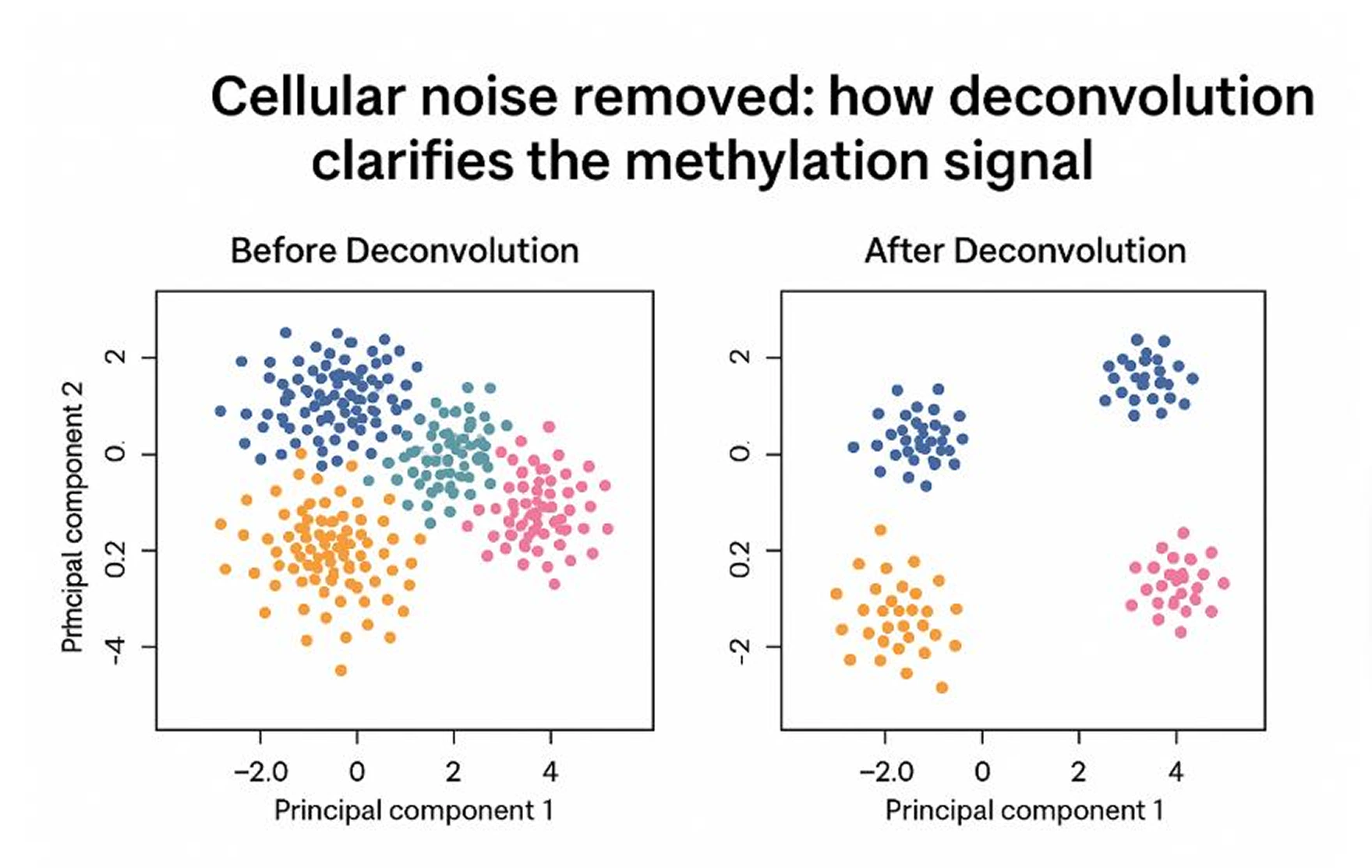
Methylation clocks and diagnostic models are only as good as the signal they’re built on. Deconvolution ensures we’re not confusing a spike in neutrophils for accelerated aging or a shift in B cells for disease.
Want to know how your T-cell methylation is changing over time? Without deconvolution, you’re flying blind.
By adjusting for cellular heterogeneity, we enable accurate comparisons across sample types—even when those samples look wildly different on the surface.
Cellular deconvolution is the bedrock for precision in methylation-based research and diagnostics. And at TruDiagnostic, we’re not just using these tools—we’re building them, refining them, and scaling them for the future of personalized health.